Chat Tone Meter: Stop Hostile Coparent Texts
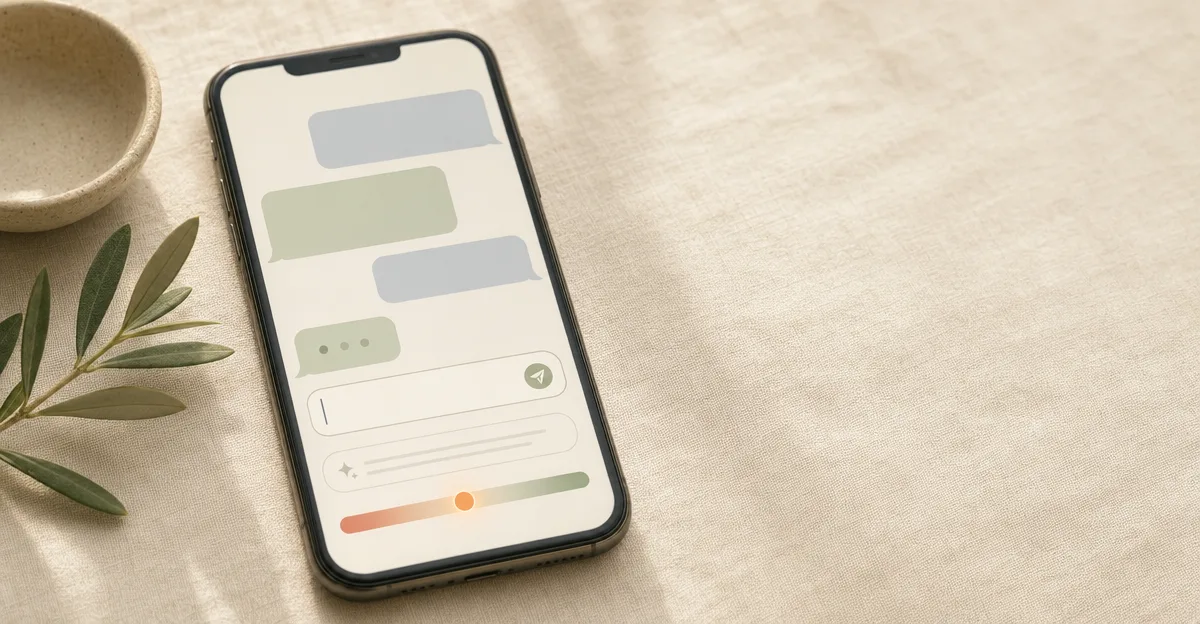
Every coparent has sent the message they regret. The one written at 10pm after the fifth late pickup. The one that was technically about the kids but clearly about something else. The one that gets screenshotted and shows up three years later in a deposition.
The new Chat Tone Meter in Kidtime is built to catch those messages before you hit send — and to give you a neutral, child-focused rewrite when you want one.
Why tone is the real conflict driver
The research is consistent: in high-conflict coparenting, it's not the schedule or the money that drives the most pain. It's the communication. Parents spend years learning to read the other person's words for hidden barbs, then firing back with their own. It's exhausting, it's bad for the kids, and it fills court records with receipts neither parent is proud of.
A dedicated coparent app already helps by creating a single, timestamped record. But a record of hostile messages is still a record of hostile messages. The Kidtime tone meter is the first layer of defense — a beat between "I typed this" and "the other parent reads this."
How the tone meter works
Before you send, you tap Scan. Kidtime analyzes your draft using a fast language model and returns:
- A tone read — calm, heated, passive-aggressive, sarcastic, blaming
- Up to three rewrites — each based on a different family-law communication framework
- A clear comparison so you can see your original next to each option
You decide what to do. Send as drafted. Edit yourself. Tap a rewrite and use it verbatim. Your choice, every time — the meter is a second pair of eyes, not an auto-editor.
The three methods behind every rewrite
The rewrites aren't generic "nicer" versions of your message. They map to three communication frameworks that family-law attorneys and high-conflict specialists have been recommending for years. You'll see them labeled in the app as Balanced, Minimal, and Polite — below is what each one actually is and when to reach for it.
Balanced — the BIFF method
BIFF stands for Brief, Informative, Friendly, Firm. It was developed by Bill Eddy, a family-law attorney and founder of the High Conflict Institute, as a way to communicate with high-conflict personalities without getting pulled into their drama. A BIFF message is short, keeps only the facts the other parent needs, leads with a small friendly phrase, and holds the line without arguing.
This is the right default for most coparenting messages. Scheduling a swap, confirming a pickup, asking about a school form — BIFF gets the job done without reigniting old fights.
See our guide to co-parenting with a narcissist for a deeper walkthrough of the BIFF method in action.
Minimal — the Grey Rock method
Grey Rock is a technique where you make yourself as uninteresting as possible to someone who feeds on emotional reactions. Applied to messaging, it means stripping your message down to one or two sentences of pure fact. No feelings. No apologies. No justifications. No openings for an argument.
Grey Rock is the right choice when your coparent uses your messages as ammunition — twisting anything you say into the next fight, or forwarding screenshots to anyone who will listen. It's intentionally dry because that's what makes it work.
Polite — the Yellow Rock method
Yellow Rock is the softer cousin of Grey Rock. Same minimalism, same lack of emotional handles — but with just enough warmth that a judge, mediator, or parenting coordinator reviewing the thread sees a reasonable person.
Many family-law attorneys quietly recommend Yellow Rock over Grey Rock when there's any chance the communication will end up in front of a court. You're still protecting yourself from a high-conflict dynamic, but you're not giving the other side material to paint you as cold or alienating.
Picking the right style
You don't need to memorize which framework to use. The meter shows all three, you read them side by side, and you pick the one that fits the moment:
- Balanced for most everyday coparenting
- Minimal when the other parent feeds on emotional reactions
- Polite when the message could be read by a court or mediator
A real example
Here's a draft from a real (anonymized) tester:
"You're ALWAYS late to pickup. I can't believe I have to remind you about your own kids AGAIN."
Tone read: Heated (sarcasm + absolute language + blame)
The meter returned three rewrites:
- Balanced (BIFF): "Just a heads up — pickup was at 4 and I wanted to make sure we're aligned for tomorrow. Let me know if the time still works."
- Minimal (Grey Rock): "Confirming pickup time for tomorrow."
- Polite (Yellow Rock): "Just checking in on tomorrow's pickup time — 4 still work for you?"
Same facts. Same expectation. Zero fuel for escalation. You pick the one that fits the relationship.
What about my voice?
The rewrites don't try to make you sound like a customer-service bot. They strip the heat and keep the content. If you want to send the original, send the original — the meter never blocks you. Most testers ended up somewhere in between: keeping their own phrasing but trimming the language that would have set the other parent off.
Privacy
Tone analysis is opt-in. Your draft is processed to produce the scan and then discarded — it's not stored with your message record and isn't used to train models. You stay in control of what gets sent.
Why both parents benefit
The most interesting pattern we see is that tone tends to normalize on both sides once one parent turns it on. You send calmer messages. The other parent replies in kind. The meter doesn't need to be a two-way install to work — but when both parents use it, average message temperature drops fast.
Getting started
- Open Kidtime and go to Chat
- Tap the Tone Meter icon below the compose box
- Scan your draft, review the read, and send with confidence
Learn more about the tone meter →
The bottom line
You can't un-send a hostile message. You can scan it first. Kidtime's tone meter is the second set of eyes every coparent needed — built in, private, and one tap away.